
What is sustainability?
Sustainable development meets the needs of the present without compromising the ability of future generations to meet their own needs. (Per Brundtland Report, 1987)
Eco-economic costs and benefits are quantified and managed comprehensively with respect to both financial and ecological balances of goods and services. (Per Brown LR, 2001)
Quantification and regulation of sustainable business development comprises application of eco-economic principles to valorize and monetize enterprise business functions. (SeaKITShub postulate)
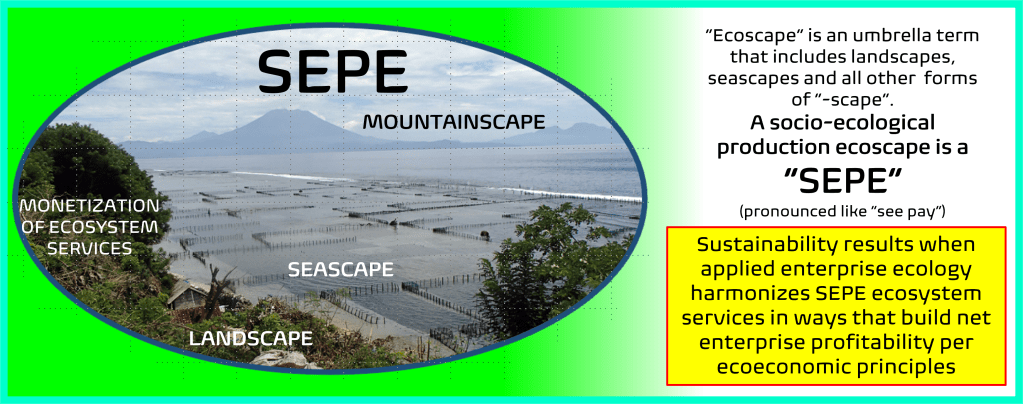
Socio-ecological production “-scapes” defined
A landscape can be defined as “an area, as perceived by people, whose character is the result of the action and interaction of natural and/or human factors” … Socio-ecological production landscapes and seascapes (SEPLS) can be characterized by a mosaic of different ecosystem types … SEPLS are managed via interactions between ecosystems and humans to create various ecosystem services for human well-being. (Saito et al 2020)
Enterprise ecology in SEPE connects supply chains to value chains through harmonized ecosystem service systems
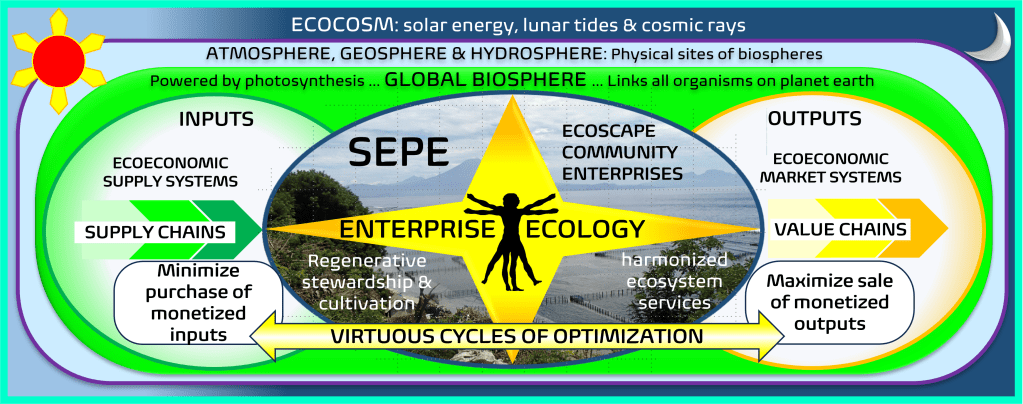
Sustainability results when applied enterprise ecology harmonizes SEPE ecosystem services in ways that build net enterprise profitability per ecoeconomic principles
Arguably, applications of sustainability metrics to business operations must use vastly different approaches, depending on whether they are for small-medium enterprises (SME) or for large enterprises (LE).
SME tend to be owner-operated enterprises dependent on trust/commitment alliances and intimately engaged with their ecosystem service bases. LE tend to be managed and operated by employees whose personal agendas vary somewhat from corporate agendas. They tend to be remote from LE ecosystem service bases. LE governance is dominated by formal legal agreements and is monitored using structured accounting protocols that require substantial bureaucratic structures. In the case of SME functioning in socio-ecological production ecoscapes (SEPE) human ecoscape denizens can be treated biologically as “biomass” integral to ecosystem services systems.
Operationally, humans manipulate ecosystem processes toward harmonization of services to humanity. Sustainability impacts can be assessed in terms of degrees to which defined actions lead to harmonious results. Harmony has been achieved when actions result in ecosystem service trade-offs that make the most of potential combined benefits to humanity.
SeaKITShub striving toward United Nations Sustainable Development Goals (SDG)
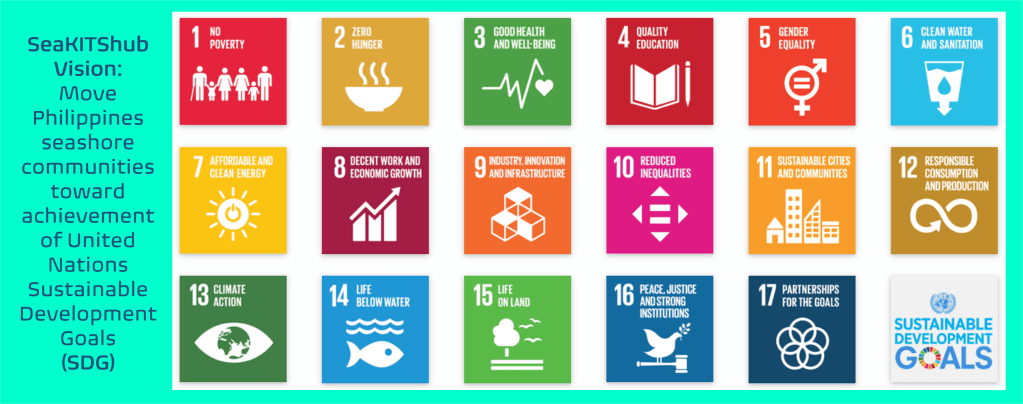
 SeaKITShub